Calculated Decision-Making

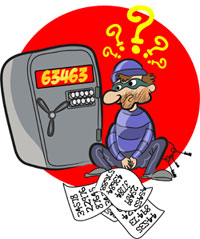
Cracking the code to the safe is hard enough. You better write down the misses as you go along!

If you were trying to break into a safe that had a five-digit combination, how would you do it? Would you haphazardly guess at the sequence of numbers, hoping you’d stumble upon the correct digits in the right order? Not very efficient, right? Would you try to uncover any clues that might help you decipher what those numbers might be? A better approach, certainly, but still difficult. Knowing on what the combination was based—birthday, favorite numbers, anniversary maybe—is difficult enough. But then you’d need to figure out what the answer to those clues might be. Whatever approach taken, cracking the code of any safe is almost impossible. That’s a good thing, right? Unless you’re a thief, that is. With 100,000 combinations (10 possibilities, including ‘0’, for each digit, raised to the power of 5 for the number of digits in the combination), you have a better chance of becoming a pro athlete (a good thing: 1 in 22,000) or getting audited by the IRS (a bad thing: 1 in 175). But if you were stupid enough to try this feat, what would be the one thing you would have to do? Document all of the failed attempts. After all, if a combination is not correct, you surely don’t want to repeat it.

But that’s exactly what happens a lot of times in business. Especially in small businesses. Often, even, in successful ones. Let’s be honest; the reasons entrepreneurs start businesses are many. But one of the more common ones is to escape the rules, policies, and overall bureaucracy they have faced as employees in other companies. And as we can all attest, there are certainly reasons to dislike these rigid systems, often designed more to play ‘big brother’ and keep employees in line than to get real work done. Read more of this post

Top n Lists with Excel

I love data! I love collecting it, analyzing it, finding answers inside it, and ultimately presenting it. But even I find it hard at times to sort through and make sense of it all. That’s why I love dashboards and really encourage all business owners, managers, and employees to incorporate them into their daily work lives. Whether it’s having a clear look into the health of the company, figuring out which expenses are out of hand, or understanding how fast (or slow) customers are paying their bills; well prepared and presented dashboards can save decision makers a lot of time and money.

One of the most fundamental things you can achieve with dashboards is the filtering of data, narrowing information into the most pertinent, important, or actionable. Commonly in the form of top n lists, where n is any number of items you care to look at, using MS Excel to organize this type of information is actually fairly simple. Even if you are allergic to dashboards or any structured system for understanding information, there are certainly other applications for it. Maybe you’re keeping a running total of the minutes your basketball players are logging, trying to avoid fatigue. Or you want to continually look at which products are your best sellers. Or maybe you just want to keep track of and reward your top sales people. Again, all of this is easy and made possible with Excel. Read more of this post

Bad, BAD lessons from the NFL Draft

Leaders in business seem to follow a lot of lessons from the NFL.  Some are good, of course.  But some are bad, bad lessons.  The 2011 NFL Draft, which commenced last night (Thursday) with the first round of selections, provides a perfect example.  While there weren’t a whole lot of huge surprises, there were indeed a few.  (Hint, the #8 pick) That is always the case.  Some players drop further than projected, while others get selected sooner than even they may have expected.  Some teams address the exact positions they need, while others operate under the philosophy to take the best player available, regardless of position.  I mean, what do we expect?  It’s human beings evaluating human beings.  What could go wrong?

Tom Brady was the 199th player taken because he didn't pass the eyeball test..

The NFL and those who make their name and reputation, not to mention a lot of money, from the draft like to pretend it’s a science, this evaluation of players.  Like business and financial analysts, they have all the data they could possibly need- some (like me) would argue too much.  They measure these players, weigh them, and watch hours and hours of game film.  They check their body weight and test their physical strength.  They have doctors evaluate the severity of any past injuries and look for the potential of future ones.  They even claim to effectively test the cognitive abilities of prospects with a test known as the Wonderlic. (Click Here to see how you measure up) Read more of this post

Timeliness versus Precision

Is Speed better than Accuracy?It’s a good thing that crow tastes a lot like chicken- and that I like chicken- because I’ve been eating a lot of it lately.  The latest portion has been served up by way of a discussion or several I’ve had with the leader of one of the companies with which I work.  The long and short of the debate comes down to the importance of timeliness versus the need for accuracy and precision.

You guys know me by now.  I’m a perfectionist.  I like things right.  I insist on putting my best foot forward.  My tagline, after all, is “Addicted to Improvement.”  It is my belief that what people produce and put out for the world to see and consume– whether in words spoken, in writings and reports created, or in physical appearance –is reflective of their personal brand.  So you should always make sure what you do is the absolute best.  Right?  Well, actually I’m wrong.  Sort of. Read more of this post