YOY Comparison for Most Recent Days

Comparing Same Day Sales YOY

In my last post, Showing Activity for Most Recent Days, I showed you how to find the most recent date for which you have “totals” data.  We found that whether it’s support calls or sales made each day, being able to retrieve this information quickly and efficiently can be extremely helpful.   By using the ROUNDDOWN AND MAX functions, as well as the very powerful SUMPRODUCT,  we were able to create a quick summary of the most recent days’ activity. The obvious next question?  How do those days compare with the same time last year.  In other words, using the most recent data, how are things going compared to last year?

We already have the first several pieces of the puzzle, the current year’s sales information.  To compare the data to last year, we simply find the totals for the same dates in the previous year.  We can determine these dates these dates fairly easy by using the CONCATENATE formula, along with the popular and well known MONTH and YEAR formulas. Read more of this post
Showing Activity for Most Recent Days

I’m working on a dashboard for a company that sell tee shirts to high school sports programs.  They get their data from an online database which includes day and time of order as well as order amount. But, you could apply the same methodology to any data that is updated often, whether you are copying and pasting into Excel, importing from or linking to an Access database, or connecting to an ODBC data source. (Of course I didn’t use the company’s actual data; I used a cool trick to generate random dates and times for events for my sample data.)

At any given point, management of Acme SportsTees, Inc. would like to see the last 10 days of sales activity.  The trick to dashboards; and in my opinion, any process or task you are trying to automate; is removing from the process as much human involvement (thinking, typing, more thinking) as possible.  So, if you are able to connect directly to the data source, or at least reduce the actions required by the administrator to just copying and pasting, you will significantly reduce the opportunity for human error and a lot of headaches. Read more of this post

Generating Random Times for Events

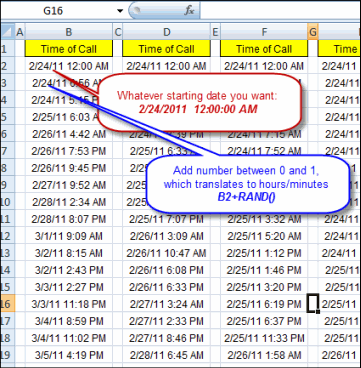
Generating Random Times for EventsIf you are ever in the need for sample data where the events (sales, support calls, etc.) occur several times throughout any given day, here is a neat little trick to accomplish that. One might think the RANDBETWEEN function, which generates a random integer between two numbers that you feed the function, would do the trick. Well, because RANDBETWEEN only returns whole numbers, the time of the day is always going to be at midnight.

To add increments that are less than one day, you would need to add numbers less than one (i.e. not whole numbers). For example adding 0.25 would take the time to 6 am; 0.5 to noon, and 0.75 6 pm. Luckily, adding a number less than one is easy. The RAND function, which generates a number between 0 and 1, does all of the work you.

To generate a list of random times, then, simply start with whatever date you wish in the first row of your data. All is needed in each cell afterward is the addition of Rand(). After adding Rand() to the previous cell, simply copy (or drag) the formula for as many entries as you wish. See attached for example. If, when you’ve finished the copying/dragging, you don’t see enough entries in each day (only 6 am, 2 pm, and 11:30 pm— 3 entries—for example), simply divide Rand() by 2 (or 3 or 4 or 5), to make the increment each time smaller. Pretty straightforward, huh?

Example: Generating Random Times and Dates

Dirty Data Again

It happened again.  I was working on a project for which I needed a quick list of all of the 50 states and their abbreviations.  I probably had it somewhere— I’m sure I’ve needed this information before—but I was too lazy to look for it.  If I was in 7th grade, I could probably have just typed them in order from memory.  But I’m not and I can’t.  So I did what any half-way smart person would do.  I googled “State Abbreviations”.  The result returned a lot of sites, as you’d expect.  I decided on using the one for our good old United States Postal Service: http://www.usps.com/ncsc/lookups/abbr_state.txt. Read more of this post

Mortgage Calculator

I have a lot of friends and friends of friends that are in real estate.  More importantly, I have a lot of friends who are home owners or soon-to-be home owners.  And I, too, am trying to navigate this grown-up stuff that includes providing a home for my family. So, it dawned on me the other day and I remembered one of Excel’s cool functions, Pmt().  Given the loan details— amount, interest rate, and term— the function returns the monthly payment.

So I decided to put together a simple Excel Sheet (form, really) that applies this function. It also highlights some of Excel’s other cool features, such as: Read more of this post