Is Stress Making You Fat? The Cortisol / Belly Fat Connection

Happy March! Spring is around the corner and so are tank tops and short shorts (for the guys…let’s hope not so short shorts). For those who have accepted the challenge of resisting soda and your diet vice for ten days, congratulations! (Please see last week’s post: https://bobbybluford.com/2011/02/22/welcome-julie/). The comments and conversations that followed my February 22nd post were both informative and entertaining, but what I enjoyed most was your honesty.

We all have vices, whether we acknowledge them or not. Lisa’s comment about wine being a “gateway drug” that leads her to make other poor diet choices is very poignant and I’m guessing relatable to many of us. Bobby’s suggestion to break habits with small successes is spot on. We must hold attainable goals. So, simply put, the “less everyday” approach, rather than the “cold turkey” approach keeps you trending in the right direction and builds your confidence and energy, which eventually translates into activity and the production of endorphins—the feel-good chemicals released in your brain to bring you a sense of well-being. Read more of this post

Showing Activity for Most Recent Days

I’m working on a dashboard for a company that sell tee shirts to high school sports programs.  They get their data from an online database which includes day and time of order as well as order amount. But, you could apply the same methodology to any data that is updated often, whether you are copying and pasting into Excel, importing from or linking to an Access database, or connecting to an ODBC data source. (Of course I didn’t use the company’s actual data; I used a cool trick to generate random dates and times for events for my sample data.)

At any given point, management of Acme SportsTees, Inc. would like to see the last 10 days of sales activity.  The trick to dashboards; and in my opinion, any process or task you are trying to automate; is removing from the process as much human involvement (thinking, typing, more thinking) as possible.  So, if you are able to connect directly to the data source, or at least reduce the actions required by the administrator to just copying and pasting, you will significantly reduce the opportunity for human error and a lot of headaches. Read more of this post

Generating Random Times for Events

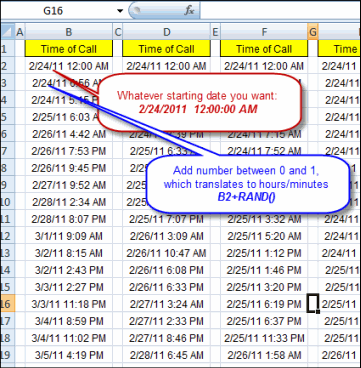
Generating Random Times for EventsIf you are ever in the need for sample data where the events (sales, support calls, etc.) occur several times throughout any given day, here is a neat little trick to accomplish that. One might think the RANDBETWEEN function, which generates a random integer between two numbers that you feed the function, would do the trick. Well, because RANDBETWEEN only returns whole numbers, the time of the day is always going to be at midnight.

To add increments that are less than one day, you would need to add numbers less than one (i.e. not whole numbers). For example adding 0.25 would take the time to 6 am; 0.5 to noon, and 0.75 6 pm. Luckily, adding a number less than one is easy. The RAND function, which generates a number between 0 and 1, does all of the work you.

To generate a list of random times, then, simply start with whatever date you wish in the first row of your data. All is needed in each cell afterward is the addition of Rand(). After adding Rand() to the previous cell, simply copy (or drag) the formula for as many entries as you wish. See attached for example. If, when you’ve finished the copying/dragging, you don’t see enough entries in each day (only 6 am, 2 pm, and 11:30 pm— 3 entries—for example), simply divide Rand() by 2 (or 3 or 4 or 5), to make the increment each time smaller. Pretty straightforward, huh?

Example: Generating Random Times and Dates

No More Freakin’ Excuses

Not Me, Unfortunately

No, that is not me.

Unfortunately.

Maybe 10 years ago, but certainly not now.  BUT, it is the front cover of a great article by Men’s Health Magazine.  We all have trouble getting motivated sometimes.  At the top of things for which we look for and find excuses– often legitimate, I’ll concede–is working out and getting in better shape.  Even I fight that voice that tells me to just go home and relax.  I usually push back with my own voice, usually resorting to one of the following:

  1. Excuses are for Losers!
  2. If you look hard enough, you can always find an excuse
  3. Excuses are for Losers!
  4. To have what others don’t, you have to be willing to do what others won’t
  5. Excuses are for Losers!

Fortunately, Men’s Health is more articulate and helpful in their approach.  In their article, 21 Ways to Overcome Exercise Excuses, you should fine just what you need (at least one or two motivating tools) to get you off your butt and get moving.

The Audacity of Success

What do Ryan Seacrest, Jessica Simpson, and Dr. Phil have in common? How about Tony Robbins? Or Arnold Schwarzenegger? Oprah Winfrey? Kim Kardashian? Yes, they are all extremely successful, but that’s not the answer I was looking for. What else? Lucky? Maybe a little, but we all have a little luck in our lives, even when we don’t choose to acknowledge it. Extremely gifted or talented in their chosen fields of endeavor? Nope. That’s certainly not it.

Okay, I’ll get to the point. The other day I was talking with a colleague of mine and I mentioned I was re-reading Tony Robbins’ The Power Within. For some reason, I was a little embarrassed to admit that. After all, even I think he’s a little, well, corny. Like many, if not most of us, I find myself talking trash about people who, let’s be honest, are a lot more accomplished than I. “She cannot sing!” Or “He’s a joke?” “How the heck did they give her a television show?” And “What is his talent, again?” In one form or another, we are saying “Who do they think they are?”

The Audacity!

The Audacity of Success. Read more of this post